
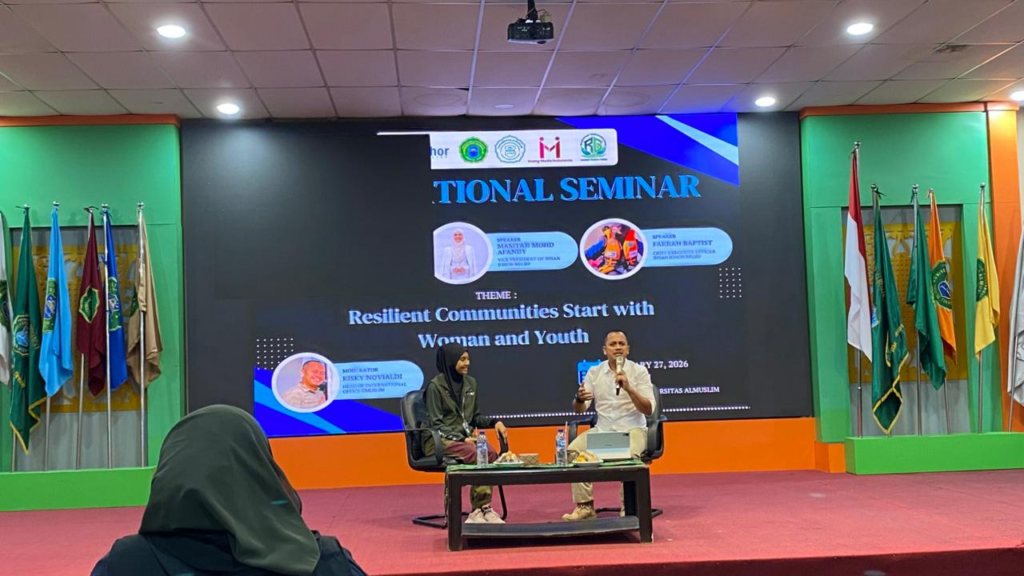
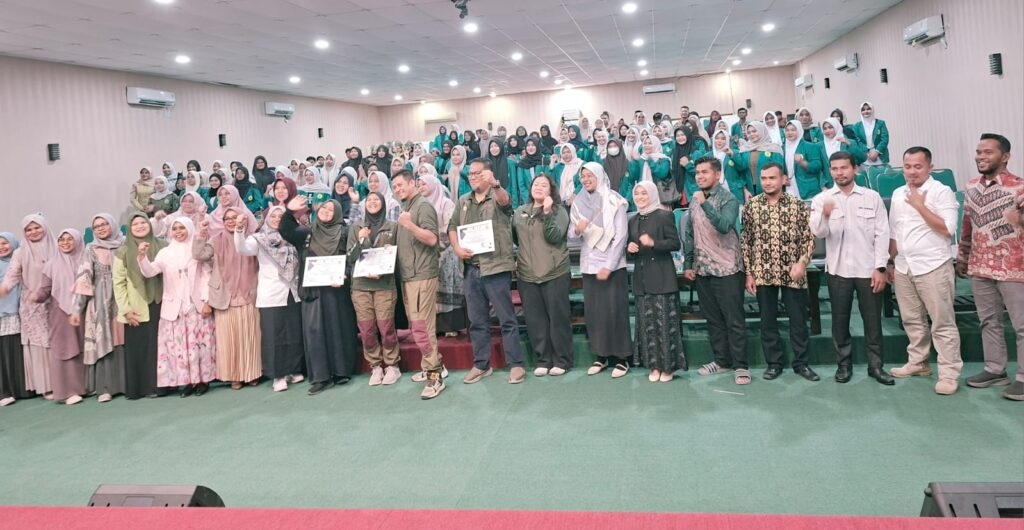
Bireuen, Almuslim University, – Volunteers from Ihsan Johor, Malaysia, held an international seminar at Almuslim University with the theme “Resilient Communities Start With Women and Youth”—a community possessing the individual capacity to adapt, bounce back, and remain resilient when facing difficult situations, pressures, and trauma—driven by resilient women and youth, on Tuesday, January 27, 2026, at the MA Jangka Auditorium.
The International Seminar was opened by Almuslim University Rector Dr. Marwan, M.Pd., represented by Vice Rector III for Alumni and Student Affairs Dr. drh. Zulfikar, M.Si., who expressed appreciation and gratitude to Ihsan Johor for organizing the International Seminar at Almuslim University, focusing on the theme of resilient women and youth communities in navigating the post-disaster transition period following floods and landslides in Aceh.
The International Seminar was attended by deans, vice deans, lecturers, 25 student representatives from each faculty, and Gleeh volunteers led by Aulia, who has been working to help clean up residents’ homes, mosques, and schools affected by the floods in North Aceh, East Aceh, and Bireuen.
A particularly compelling and extraordinary highlight was the presentation by Masitah Mohd Afandy, Vice President of Ihsan Johor Relief—a renowned female figure from Johor who is visually impaired yet inspires others to work despite her disability, relying on her beloved husband to assist her in her daily activities. She recounted the events she experienced several years ago, yet managed to rise above them with resilience—a story that motivated the students to care about Aceh’s situation amid the flood disaster.
The event was highly engaging, moderated by Rizky Novialdi, Head of the International Relations Program at the Faculty of Social and Political Sciences, Umuslim University, leaving seminar participants in awe and clapping with delight at the questions posed to Masitah. Masitah admitted she was deeply moved by the flood refugees in Aceh living in evacuation tents, who requested the Quran rather than food aid. This contrasts with other countries she had visited during disasters, where food aid was prioritized.
So, how can refugees rise again in the face of the difficult times following the flood disaster? Masitah added that within our own provisions, there are also provisions for others; this means we live for one another in mutual care.
Next, Speaker Farrah Bapteis, along with Mohamed Ridza bin Busu, President of Ihsan Johor Relief, highlighted that flood disaster evacuees need clean water, so Ihsan Johor volunteers are assisting with the construction of a borehole well in Riseh, North Aceh Regency.
Farrah added that life is one of mutual dependence, where the wealthy need the labor of the poor, and the sick need the help of the healthy. The government needs NGOs to handle disaster and emergency issues. The government cannot resolve disaster issues on its own, so it needs volunteers to help address them.